
Lunuganga, meaning salt river, is near the coastal tourist town of Bentota in Sri Lanka. It is a garden of vistas and beauty, and a garden often more about art and buildings than plants. It is about landscape, on both a large and small scale.
The garden was built over many years by Geoffrey Bawa (1919-2003), one of the great hotel architects of the 20th Century. He is described as a tropical modernist and believed particularly in merging the outdoor and indoor, something only practical in the tropics, where temperatures are always warm and can be managed by breezes and shade.
The indoors then can merge with the outdoors, which is a bit of a conundrum, as we tend to think that gardens are outside, not in. But perhaps in a Bawa garden, gardens can start inside with a view out, or even outdoors with a view in and then out again. Views are certainly important for Bawa, as his buildings and Lunuganga show.
Lunuganga is built around his country home, where he might spend the weekends after leaving his office in the Sri Lankan capital, Colombo. The house and garden is built on a peninsula in a tropical lagoon, with water readily visible on two sides, north and south.
The classic view is that featured above. From Bawa’s living room, the glass doors take you out onto a patio where you can look north, through the magnificent branches of an ancient frangipani tree (Plumeria obtusa), at a terrace, then water and then the tree-covered land beyond.
A visit to Lunuganga begins at some wide gates, flanked by two little lodges with pointed roofs (1). (Click the map below to enlarge). Here you leave your car and walk up a wooded driveway toward the house. You are overshadowed by huge tropical trees as you turn through more than 90 degrees to approach the house.

3. Eastern Terrace 4. Black Portico 5. Water Gate 6. Blue Pavilion 7. Field of Jars
8. Small House 9. Cinnamon Hill 10. Windmill Tower 11. Guest Houses
12. Northern Terrace 13. Main House and Finish
The house is of a traditional design, with white walls and curved tile roofs, never more than a couple of stories high. But punctuated with occasional towers which hold water tanks. Steps and more gates welcome you to a square and a ‘loggia’ where you enter the rooms, courtyards and perambulating levels of the house.
The first room you enter is the Garden Room (2), in which you turn to the left and begin an anticlockwise route around the garden. The Garden Room, cleverly perched above Bawa’s garage, has large doors and a portico which enter onto a terrace (3) to the east of the house.


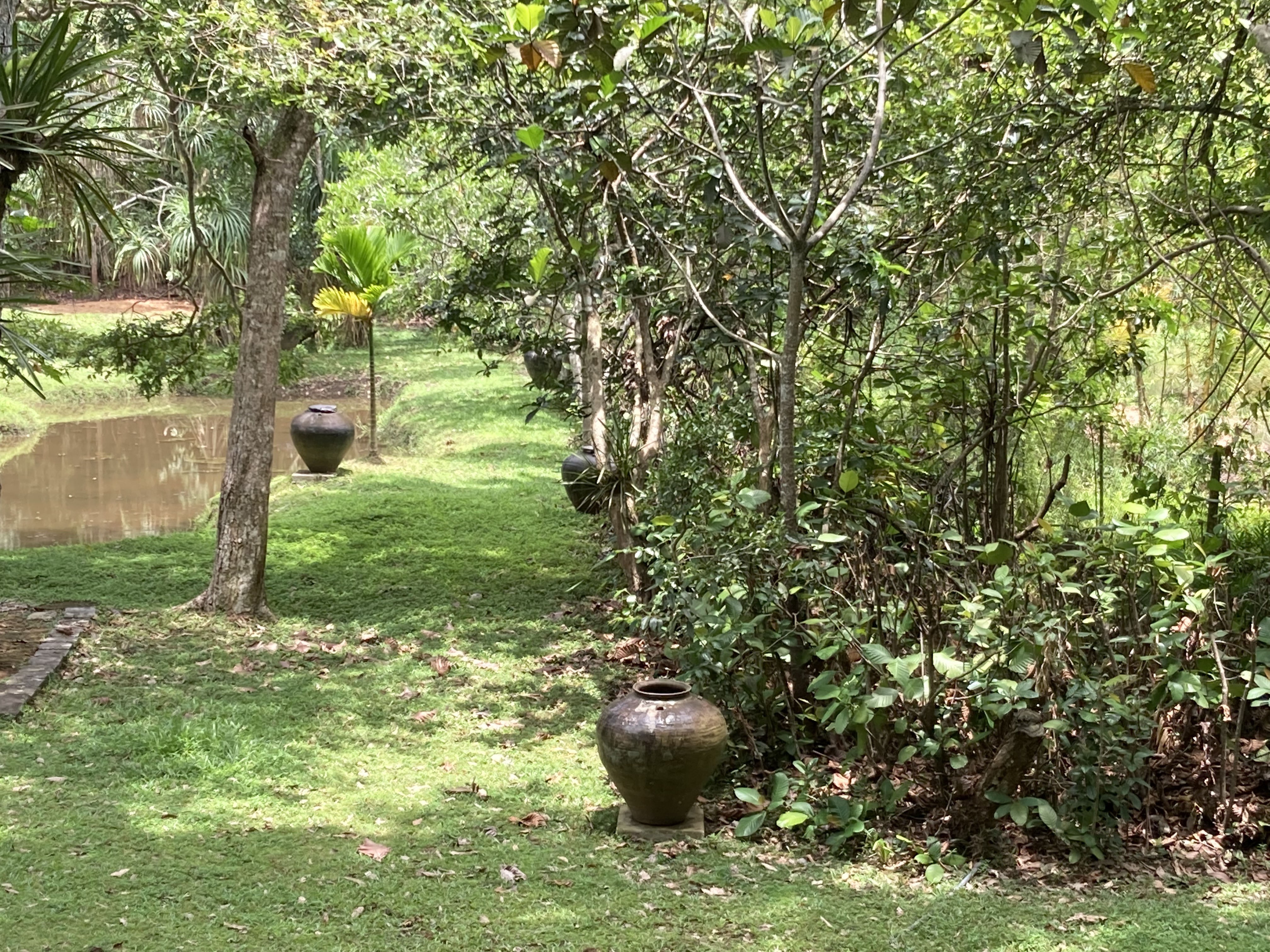
A raised lawn with antique Chinese vases is on your left, while on your right there are a few picturesque buildings including the ‘Hen House’, as the ground falls away giving you a view of lily ponds and a bench, known as the Black Portico (4).

The Black Portico is a place where the architect used to sit and admire a view westwards along a straight avenue called the Broad Walk. On the left is the house in the trees, and on the right, paddy fields and beyond them the lagoon. In the foreground is a bridge, then an island with sculptures and a walkway. It is surrounded by ferns and water lilies.

Walking along the Broad Walk, the views are to your right, across the paddy fields and out to the lagoon, known as Dedduwa Lake. Old frangipani trees line the way, and the shoreline is decorated with a balustrade and classical vases.

You can approach the lagoon from the Broad Walk to a paved area known as the Water Gate (5). You might catch a glimpse of a leopard statue or a large stone ball on the water’s edge.

When you get to the end of the Broad Walk the path turns slowly to the left, bringing you up wooded steps and back towards the house.
Here there’s a little shelter known as the Blue Pavilion (6) which looks west to an area known as the Field of Jars (7). It’s said there are six jars here, plus a reflective pond and a well with an elegant wrought iron cover.

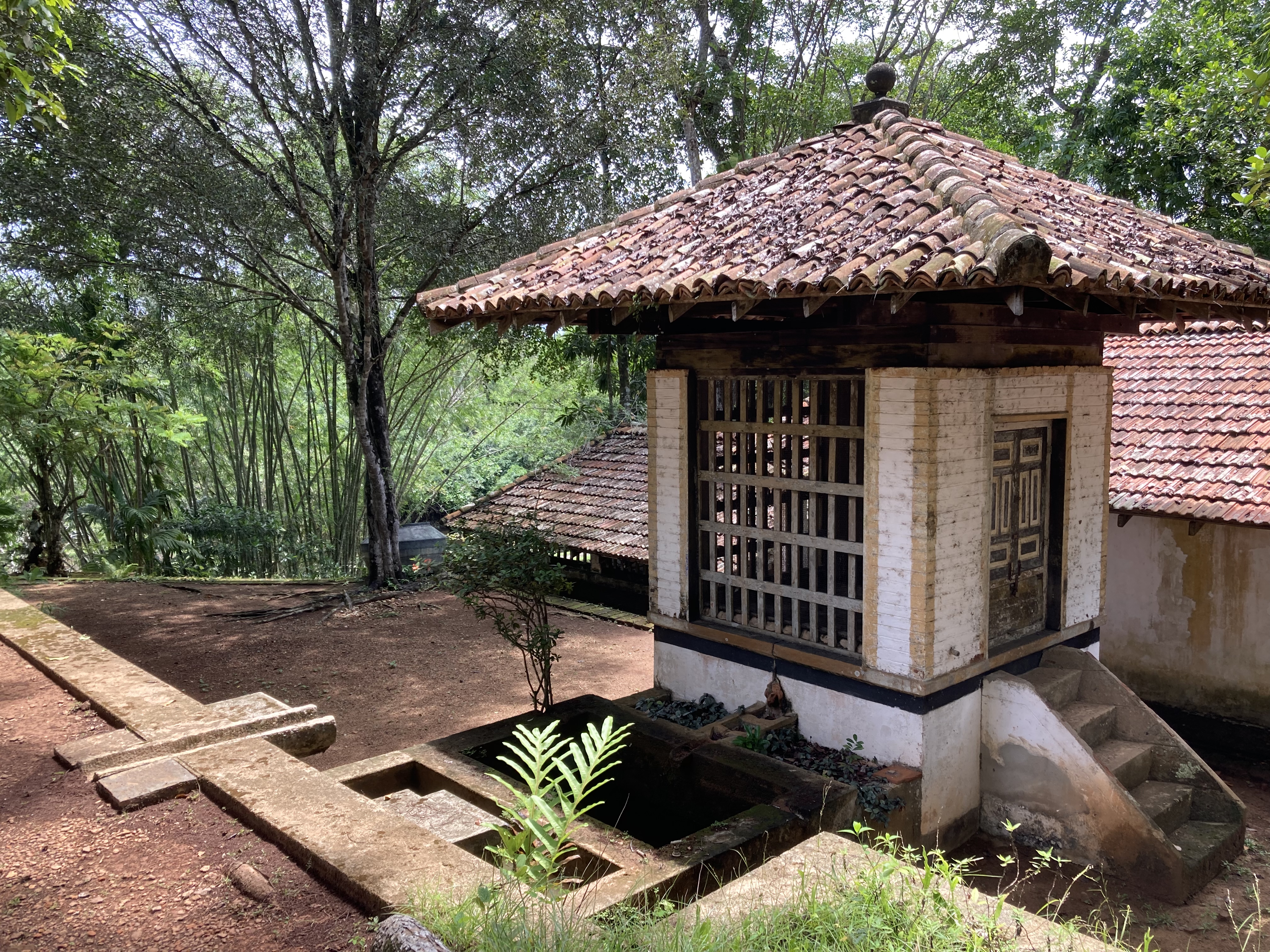
From here the tour takes us to the Small House (8), which stands on the corner of the drive where we came in. From this side we see the stairs and the wrought iron railing, while to the right there is the entrance to the veranda which takes us across a sunken lane to Cinnamon Hill (9).

Back in Geoffrey Bawa’s day, Cinnamon Hill (9) was marked by an ancient Moonamal tree (Minusops elengi) and a Ming vase. Today the old tree is gone and has been replaced by another, but the vase remains.

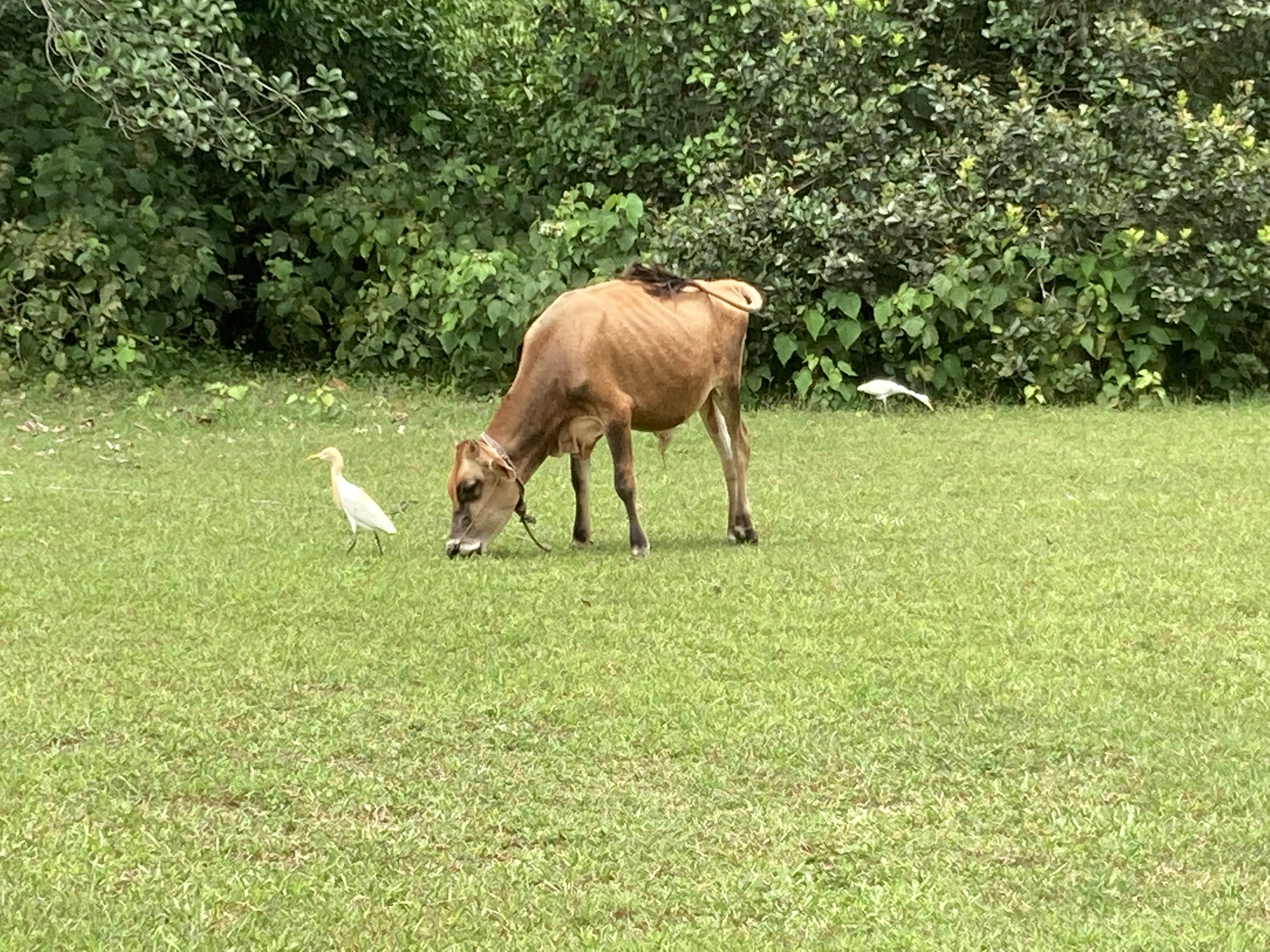
Walking over the hill, named after an old cinnamon plantation, the lagoon becomes visible on the southern side. Here cows help keep the grass short, accompanied as is traditional in Sri Lanka, with an egret or two. And to the right side, one of several brick towers supports a windmill used for raising water (10).

Then at the far end of the garden, what were once described as ruins have been transformed into picturesque chalets (11) that are available to rent out. They enjoy the view toward the lagoon.

Heading back to the house, the tour takes us to the Northern Terrace (12). It is here that the large old frangipani tree gives us the view of the lake and far shore through its branches.

Bawa built the terrace to create a space on this side of the house to enjoy from the living room windows and space north of the house. And he embellished the view with one or two Roman statues of naked youths to give a classical and homoerotic atmosphere.

The windows that get these views are the north facing ones in Bawa’s former living room. Those facing west give entry to a conservatory with views of the forest trees.

The living room reflects Bawa’s taste in the garden. Muted natural tones and the contrast of black and white, with little in the way of bright colour. Here polished brown concrete floors match the antique Burgher furniture and contrast with the white walls and fabrics.

Bawa’s bedroom and private rooms are not open, but he had a private enclosed pool and a small terrace where he had his breakfast.
It is said that Bawa also carefully considered the view from this table, to the south towards Cinnamon Hill. In Capability Brown fashion, he had the hill lowered and a country lane sunk down so as not to interfere with the vista across the water to a resplendent white Buddhist temple. Unfortunately, the temple is now hidden by trees.

Some plants
I cannot finish without mentioning a few plants you can see at Lunuganga. Firstly the pinky blue water lily that is the national flower of Sri Lanka, that abounds in lily ponds by the Black Portico.

And everywhere in Sri Lanka you can see the largest fruit in the world: Jackfruit, which may weigh up to 55kg. It makes and good curry if picked before it’s ripe and has large and tasty seeds which are also edible. When ripe it is sweet but I have never had that in Sri Lanka, although it is popular in Thailand.
Sri Lankans say that cutting down these trees is illegal in their country as destroying it threatens to starve the Sri Lankan people.

Creeping over slightly shaded damp stonework in Sri Lankan gardens you might find Episcia cupreata, the flame-violet. It has charming patterned leaves and the bright scarlet flowers that are hard to forget.

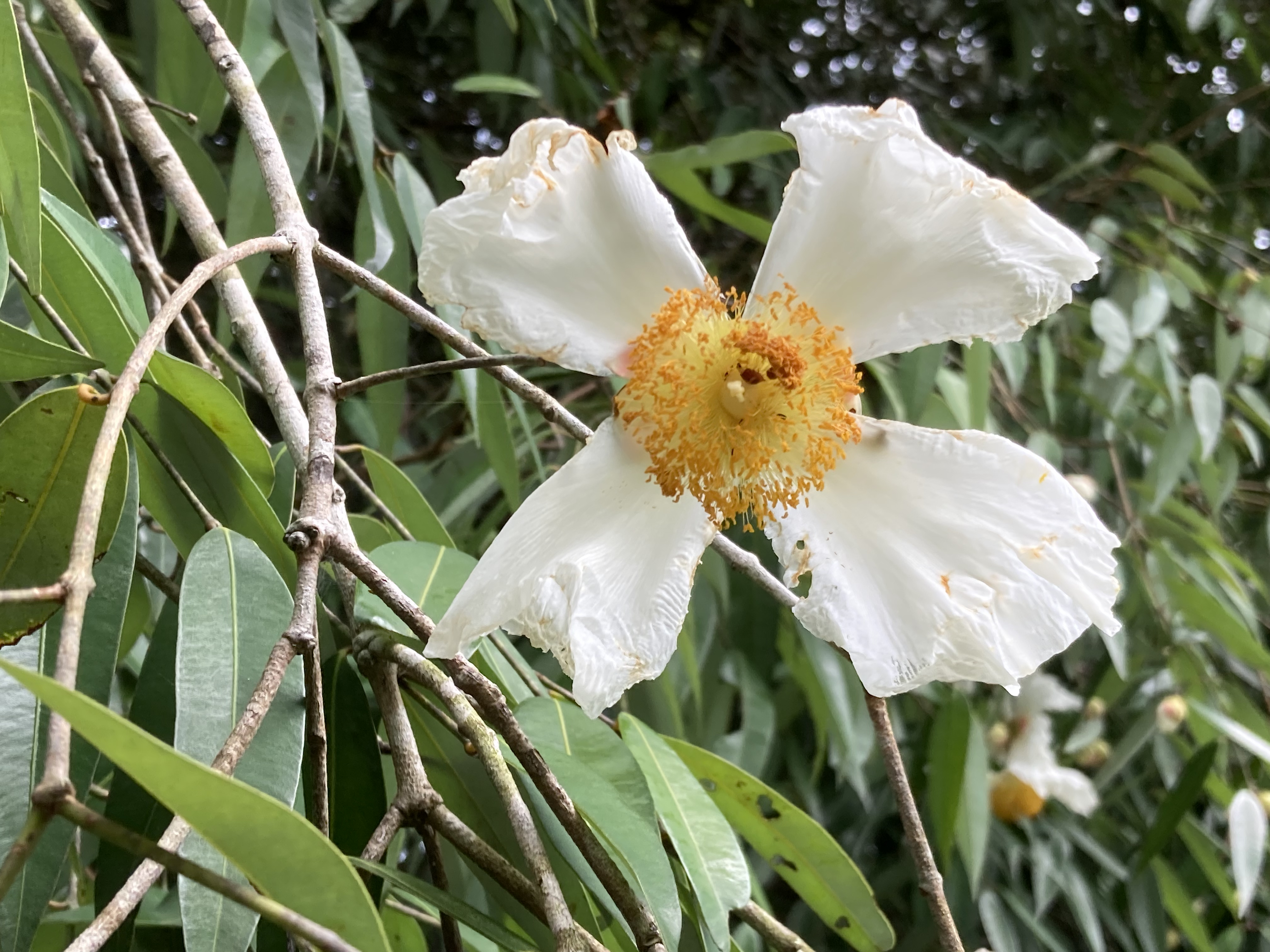
Planted just to the west of the house is a Ceylon ironwood tree, which has a great religious significance in Sri Lanka, and under which several Buddhas are thought to have achieved enlightenment. And there is evidence it was widely planted around ancient Buddhist sites such as Dambulla, Ritigala and Kandalama and still survives there.
Ironwood is the national tree of Sri Lanka. It is graceful with reddish pink branches of young leaves and a fragrant white flower. The wood is incredibly dense and hard.
Also in the woodland surrounding the house is the large yellow-flowered shrub Dillenia suffruticosa. It has various medicinal uses and the leaf can be used for holding food. But the plant is also regarded as an invasive weed.

Dotted around Lunuganga are several huge basket ferns (Drynaria sp.) which are highly architectural plants. This one sits magnificently on a rock in woodland, while others may clasp the trunks of trees.

Useful references:
Garden website: lunuganga.com
Book: Lunuganga by Geoffrey Bawa, Cristoph Bon and Dominic Sansoni. Marshall Cavendish Editions, 2006.
 gardentrip.co.uk