Tag Archives: Brachychiton populneus

Gardens of MONTJUïC, Barcelona: 4. Gardens of Mossèn Costa and Llobera

When you come to the southern end of the Miramar garden you’ll find a restaurant and on its right hand side, some stairs which allow you to descend into the Gardens of Mossèn Costa and Llobera. This is a delightful subtropical garden of palms, cacti and succulents perched over the harbour on the sunny and well drained eastern slopes of the mountain.

The green notices tell us that the garden was built by architect Joaquim Maria Casamor and gardener Joan Pañella in an area previously occupied by military batteries. It totals 6.15 hectares and was opened in 1970. It benefits from being sheltered from north winds and is generally two degrees higher than the rest of the city.

It’s surrounded by steep cliffs and old quarries. Huge Washingtonia palms from California and lots of large cacti create an amazing landscape.

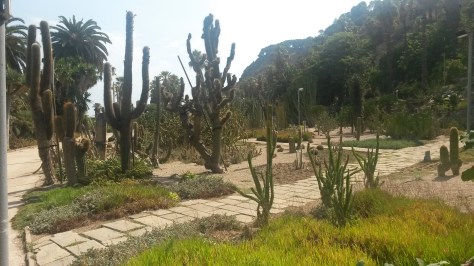
Washingtonia robusta palms from California and Phoenix dactylifera date palms
An amazing landscape…

There are also some great views across the harbour.

Views across the harbour
Visiting cruise liners on show

It’s a pleasant way to walk slowly down the hill with plenty of plants to see. Who knows what you’ll find in flower, but I am sure there will be plenty whatever the time of year.

There are many of these barrel cactuses – Echinocactus grussonii – which rejoice in the Catalan name of “seient de sogra”, which translates as mother-in-law’s seat.
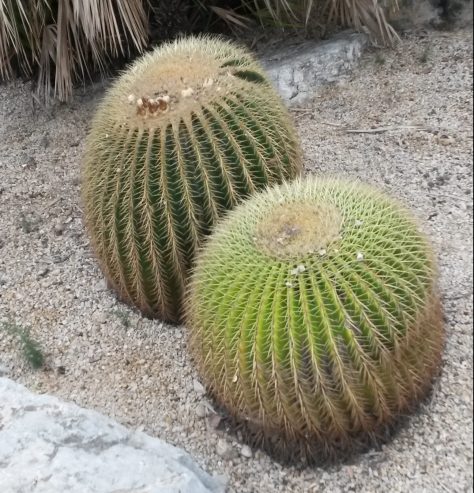
Mother-in-law’s seat – Echinocactus grussonii
Echinocactus grussonii in flower

A green notice in the garden tells us that E. grussonii grows fast and does not flower until it reaches maturity. It’s appearance and its easy reproduction make it one of the most cultivated cacti in the world. But in its natural habitat – Querétaro, in the centre of Mexico – it is restricted and almost extinct due to uncontrolled ploughing and the development of a reservoir.

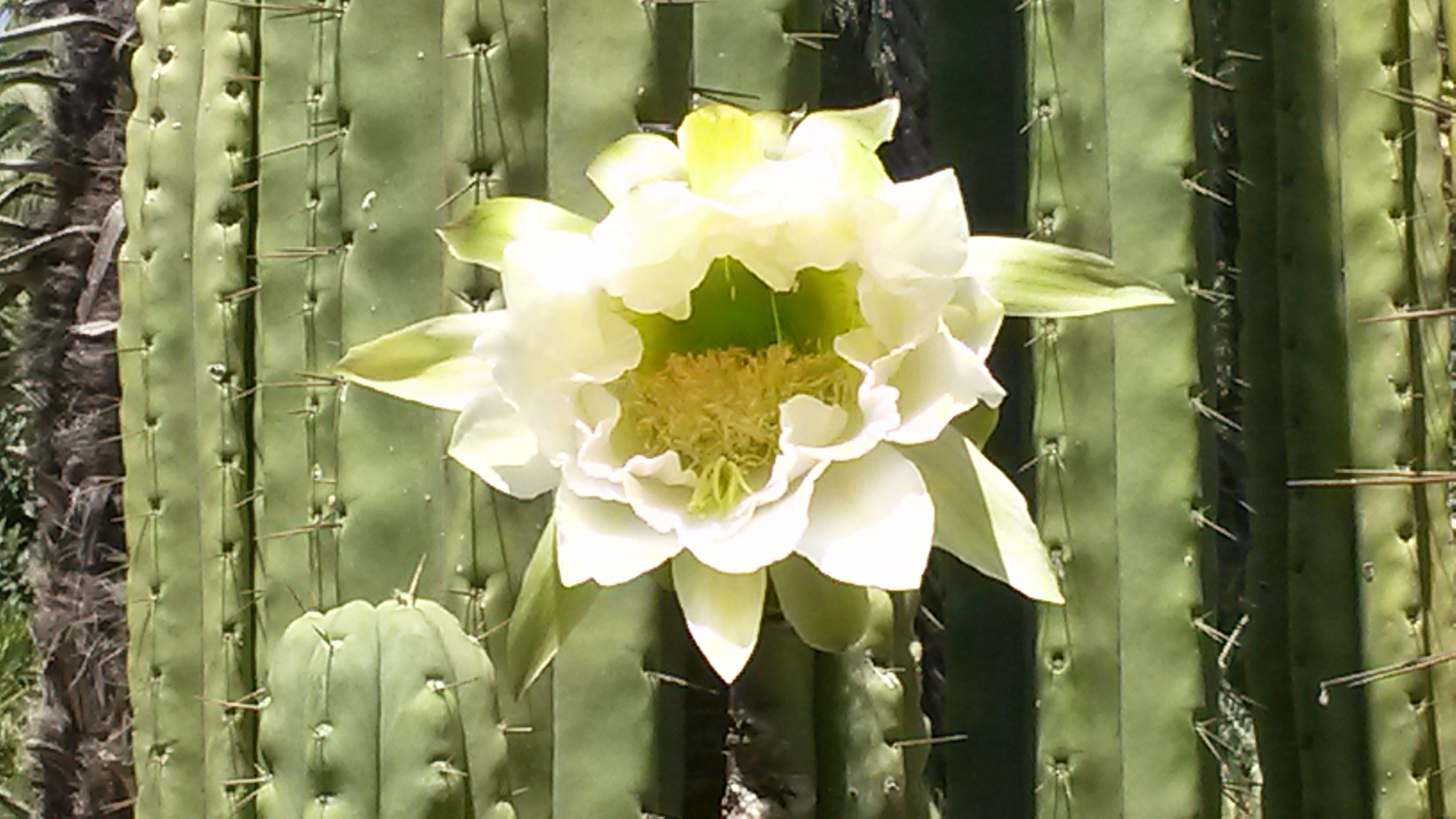
In summer I saw these flowering cacti, but I don’t have names:

Amazing trees in this garden include the Australian flame tree, Brachychiton acerifolius, with its bright flowers and large characteristic seed pods.

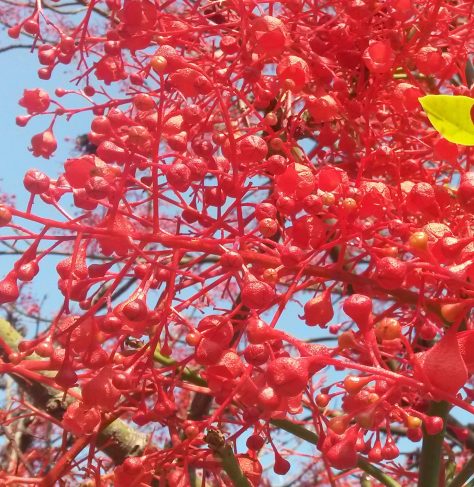
Brachychiton acerifolius, Australian flame tree, with a view of the port
B.acericifolius: Intensely red bell-shaped flowers
B. acerifolius: Large pods containing seeds which are characteristic of the genus. The pods also contain irritant hairs so should be treated carefully

This is not the only Brachychiton species planted in Barcelona. Widely planted in parks and streets is B. populneus, a handsome tree appearing a little like a weeping fig when mature. However it has white flowers freckled pink inside and pods like those above but smaller. Be careful of the pods if you see them as they contain hairs as well as seeds which can be irritable.
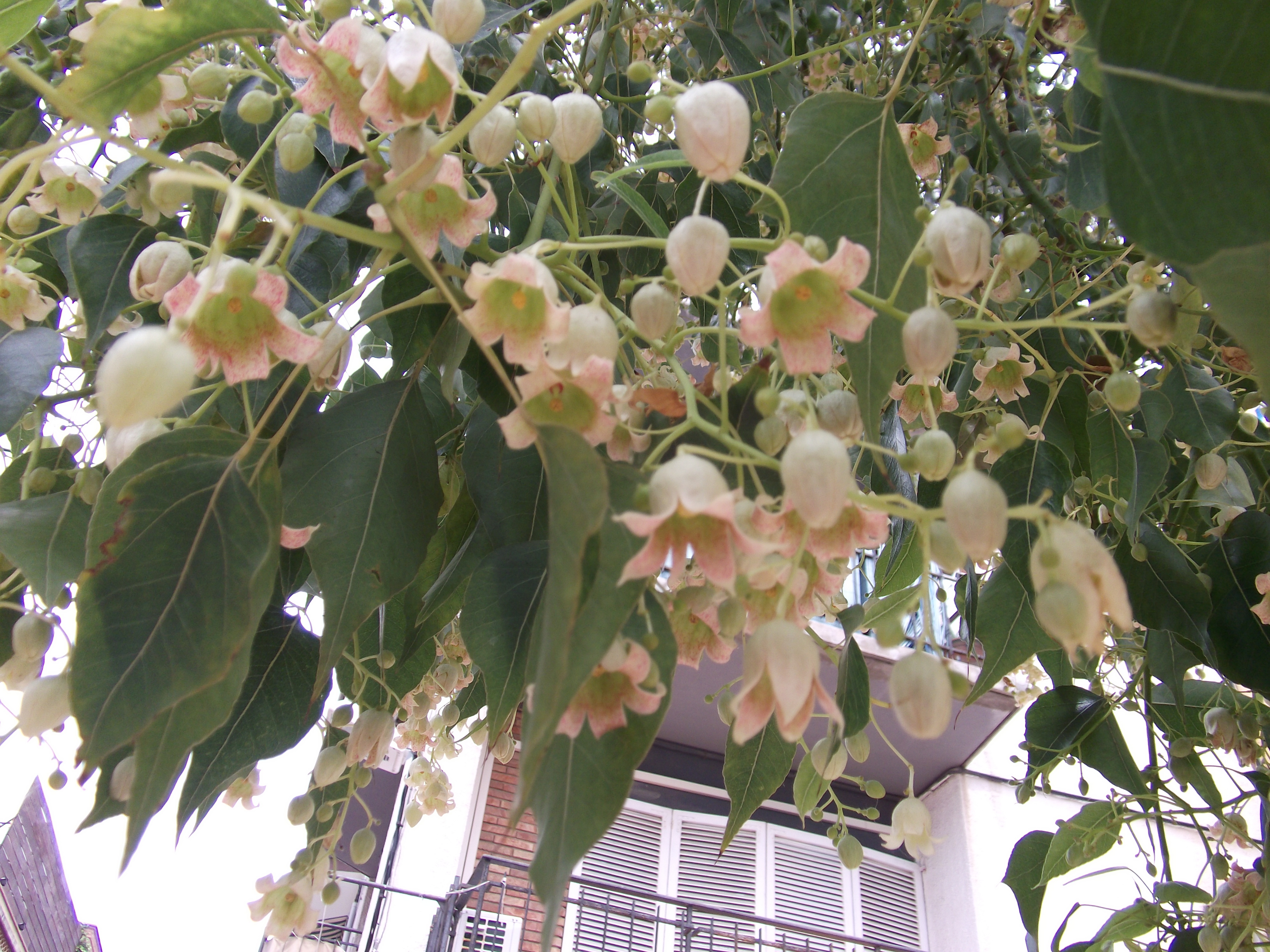
B.populneus in flower in Barcelona in early June

Brachychiton trees come from the east coast of Australia. There are about nine species which are all generally called Kurrajong. The genus was classified in the family Sterculiaceae but is now considered part of the very broadly defined Malvaceae, as is the family Bombacaceae. See the Ceiba trees in the Porta de MontjuÏc.

Another member of the genus in the garden is the Pink Kurrajong, B. discolor, which I found flowering at the end of July 2016.

Brachychiton discolor, the Australian Lacebark Tree or Pink Kurrajong
Brachychiton discolor flowers

Other great trees are the Washingtonia robusta – the Californian palms which are a characteristic of Los Angeles and the southern part of the state. There’s a grove of Brahea armata – Mexican blue palms – with their long inflorescences. A native of Baja California.

Brahea armata: the Mexican blue palm

There are many desert plants to interest you and what you find will depend on the season. But I don’t think there will be a time when you will be bored!

Agave stricta in flower

When you’ve had your fill of cacti and desert plants, walk to the lowest most northerly end of the garden and leave by the lower gate. The path runs parallel to a major road and you will pass on your right the Forestier steps – an incomplete staircase intended for the 1929 Exposition.

The Forestier staircase – never completed but it can take you back up to the Miramar Gardens

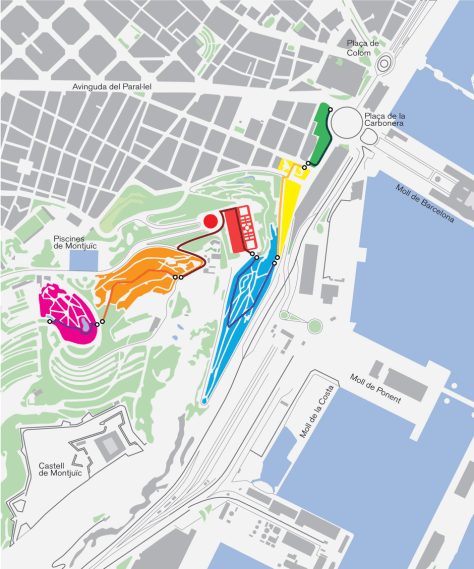
You are now walking toward the Walter Benjamin Gardens and the Porta de Montjuïc: Moving from the blue area on the map to the yellow and the green.
Gardens of MONTJUÏC, Barcelona: 5. Walter Benjamin Gardens and the Porta de Montjuïc

The Porta de Montjuïc is the highlight of this part of the garden route and could be the start of your experience, in which case see the bottom of this blog. However, if you are approaching from the Gardens of Mossèn Costa and Llobera in my previous blog, you will pass the Forestier stairs on your right and then walk down pleasant series of steps surrounded by jacaranda trees.

In April or May these will be inundated by lovely blue blossom. However, I’ve never seen it myself – just one or two remainders later in the year.

Jacaranda mimosifolia in flower

Walking down these steps, you are in the yellow area on the map. At the bottom turn slightly left, cross a minor road and find a small urban park called Hortas de Sant Bertran. There’s little to say about this urban garden, so walk through it and slightly to the left you will encounter a green space running along the side of the main road. This is coloured green on the map and is the Walter Benjamin Gardens.

Walter Benjamin Gardens

These gardens comprise three tree-lined squares, trying to create a calm shady sitting space in a busy urban environment. Each square is planted with a different tree species and there are some focal points such as stone pyramids and a fountain.

These gardens take their name from a German literary critic and were designed by architects Daniel Navas, Neus Solé and Imma Jansana, the green notices tell us in Catalan.

Not foreseen by the designers is the dazzling graffiti provided by the local youth. It may detract from the calmness but it is not unattractive and does not stop people snoozing here! In fact more recently it’s clear there are people actually living under the shade of these friendly trees.

Dazzling graffitti is now part of the Gardens of Walter Benjamin

A notable tree here is Parkinsonia aculeata, which you are unlikely to see in the UK. It is in the pea family, Fabaceae, and widely planted as a street tree in Catalonia. It’s a native of Mexico and, apparently, an invasive species in Australia.

Parkinsonia aculeata

Barcelona can be proud of its street trees, which are diverse and undoubtedly reduce temperatures and pollution big time. There are at least 150 species and you can see a list here, but I can tell you that it is not complete! One of my favourites, Brachychiton populneus, is missing!

In the other two squares we have a red-leaved plum or apple tree and a green-leaved Judas tree (Cercis siliquastrum), which must be lovely when enriched with its purple flowers in spring. There’s also a good deal of Robinia pseudoacacia along the roadside.

A square with Judas trees – in spring the trees will outshine the graffitti!

Porta de Montjuïc

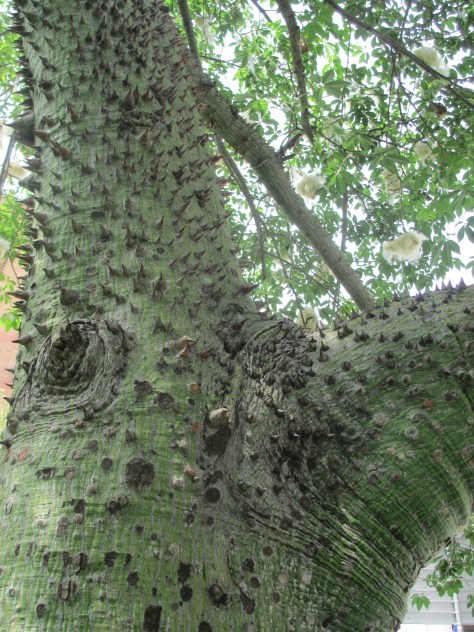
The Walter Benjamin Gardens then give on to the Porta de Montjuïc and you are back in the city. The grass verges are planted with magnificent Ceiba silk floss trees with their bottle-shaped trunks and very severe spines. I have of course featured these in my Amazing trees section.

Ceiba trees populate the grass verges of Porta de Montjuïc
The trunks and branches can be fiercely spiny

If you are lucky they may have showy flowers or silky fibrous fruit. They are from South America and were classified in the Bombacaceae family – close relatives of the kapok, balsa wood and baobab trees. However, taxonomists now believe that the concept of the Bombacaceae is flawed because it is “polyphyletic”, that is it has more than one evolutionary origin. It is now regarded as part of the Malvaceae, a very large family including the wild mallow Malva and the garden Lavatera. The is also true of the Sterculiaceae, as we saw in the Gardens of Mossèn Costa and Llobera.

Ceiba speciosa in flower in Barcelona
The fibrous fruit – similar to kapok

According to Barcelona City Council there are two species planted here – Ceiba speciosa and Ceiba insignis. I am not sure how different these two are. But there are certainly many species of Ceiba – some of which are real giants of the rainforest with huge buttress roots that tower over all other trees.

Ceiba trees are of very special importance to South American culture and it is worth giving Wikipedia a read on the subject. Think of links to Pre-Columbian and Mayan gods and the underworld, an ingredient of hallucinogenic drinks, the national tree of Guatemala and so on.

And I can’t help speculating why on earth these trees might have evolved such huge spines. My idea is that that they may have been a suitable defence against Megatherium, the giant ground sloth. It was at least the size of an elephant and used to roam much of South America in the Pleistocene, making a meal of any tasty trees.

Anyway, Ceiba are certainly interesting trees and a worthy endpoint to a day spent visiting the Gardens of Montjuïc!