I spent a week on Gran Canaria over New Year in 2020. I didn’t do much apart from appreciating the sun and warmth. But I couldn’t help but notice these lovely plants in gardens around Maspalomas.
Just in the hotel grounds there were a few things to grab my attention. Here’s a beautiful aloe which I think it would be unwise to attach a name to – there seem to be too many to choose from!

I looked through a good number of pictures on the California-based Dave’s Garden website where there a host of postings on the different kinds of aloes, all by Geoff Stein. Rather than giving me any confidence in an identification, I realised it’s a very diverse genus with all sorts of hybrids.
These stems were about 1 metre high and the flowers were a gorgeous lemon yellow. It could well be just Aloe vera, the widely grown medicinal plant which is unlikely to flower if grown indoors.

Also in the hotel garden there were the classic shrub Hibiscus rosa-sinensis, which is too pretty to be called the shoeblack plant, which is what one website calls it. Let’s just call it the rose of china!

Nearby another shrub which I didn’t recognise was the yellow flower Turnera diffusa, with its plicate leaves. It’s in the passion flower family, the Passifloraceae, and one of its English names is damiana. I didn’t try tasting the leaves but they are supposed to be spicy and this plant has some useful medicinal properties. It has been shown to be protective against gastric ulcers and even an aphrodisiac.

And this pink clerodendron was also in the garden, a shrub about a metre high. I didn’t recognise it as a clerodendron, which is familiar to me as a tree planted on Hackney streets (probably C.bungei). It flowers in the late summer and has thick evergreen leaves.
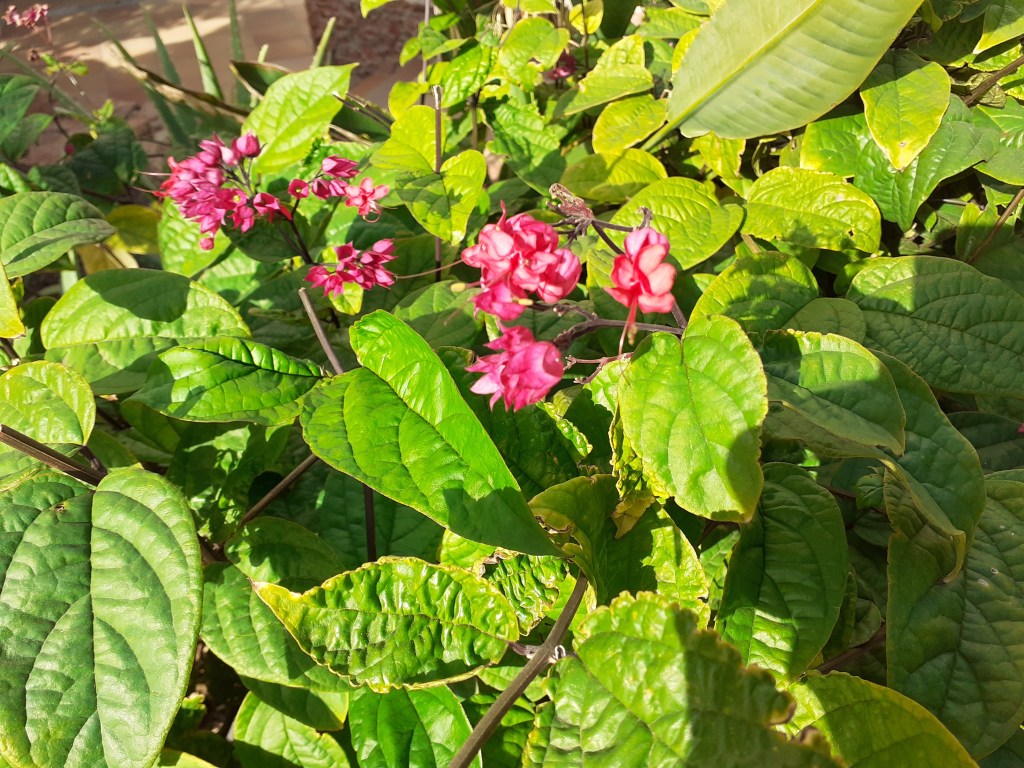
What’s worth noting about clerodendron, which belongs in the mint family – Labiatae or Lamiaceae as it’s now called – is that the flowers have a calyx of coloured sepals. This then produces a flower which is zygomorphic with very prominent stamens. In this case the flower petals and the sepals are almost the same colour so difficult to distinguish. This is not always so, the calyx can be much paler. Clerodendrons can then go on to produce usually dark purple berries which are still surrounded by the pinkish sepals.

Out and about on the streets of Las Palomas there was Lantana camara being grown as a hedge. It can be prickly and it is widely grown in greenhouses in UK butterfly farms – if such things still exist. No doubt it produces plenty of accessible nectar for such insects. It is in the verbena family, Verbenaceae, not at all hardy and is apparently toxic.

Another hedge was this rather unruly plant – Acalypha – which was about 2 metres tall. It’s in the euphorbia family, Euphorbiaceae, and is noted for its variable coppery or red leaves. In English it’s called copperleaf or Jacob’s coat.

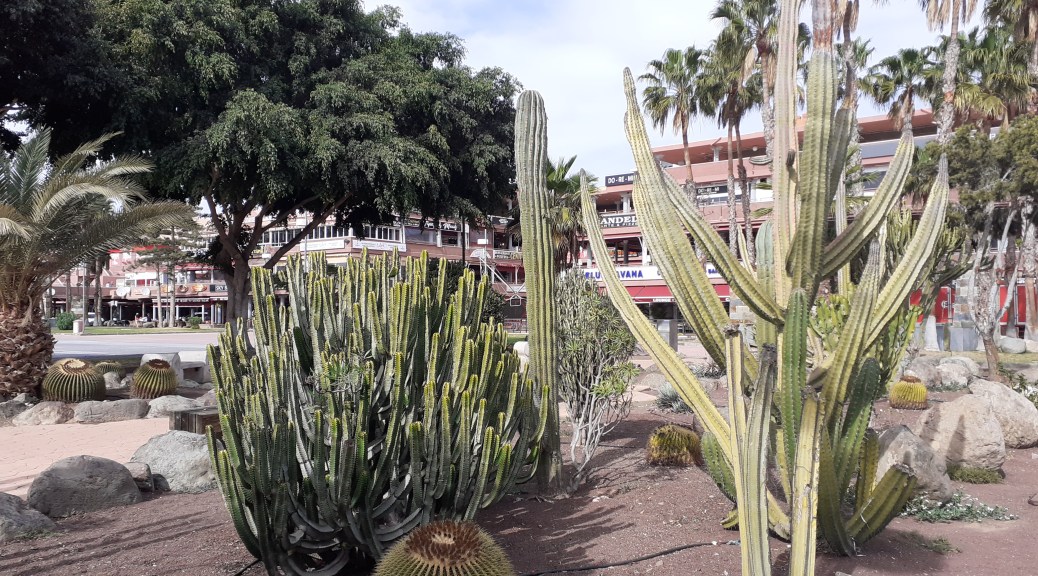
If there is a centre to Maspalomas it is the Yumbo Centre which is a sort of 1970s concrete shopping mall with a garden at its centre. Here there’s some grass, a few sculptures and rocks plus a planting of palms, succulents, cacti and exotic trees.

Always dominant are the beautiful Washingtonia palms which in fact come from Mexico but are most famous for me as the trademark of Los Angeles. They became an icon when painted so often by David Hockney back in the 1970s.

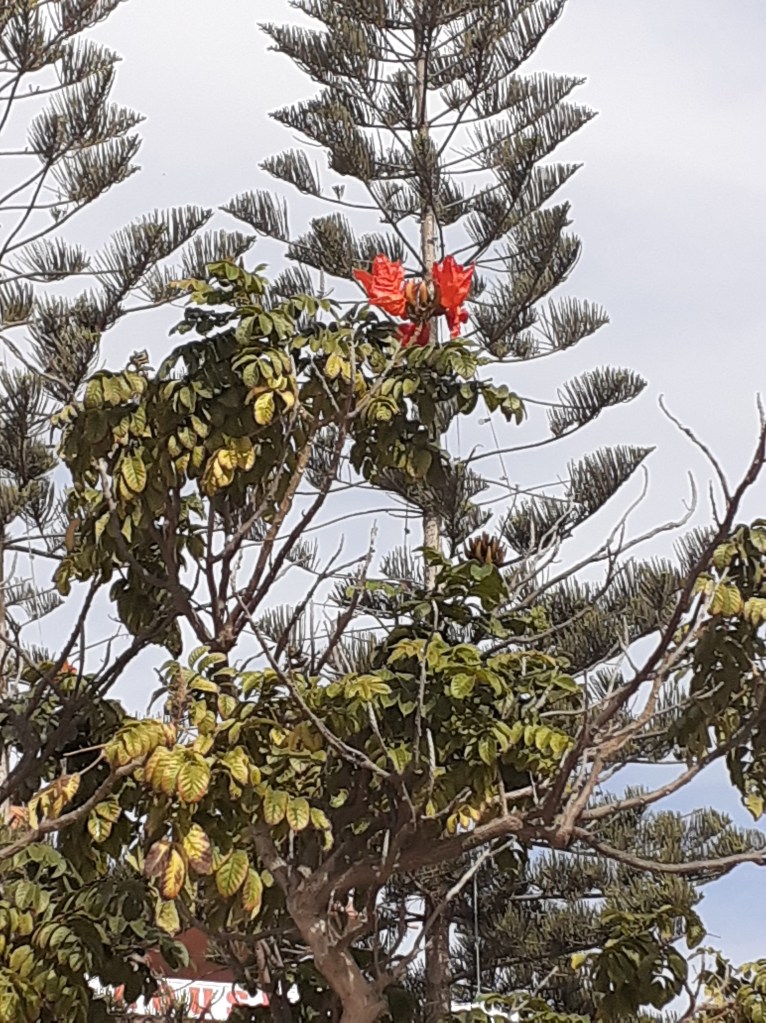
There’s also Norfolk Island pines, Araucaria heterophylla, commonly planted on the island, and I think the African tulip tree, Spathodea campanulata. It’s flowering but looking a bit dried up – probably a result of incessant wind at this time of year.
Out on the streets I noticed this recently plant palm tree, which I think is quite attractive. It has plumose leaves – that means the leaflets are attached to the spine of the leaf at several angles, not just at 180 degrees producing a flat leaf like a date palm.

I’ve always found identifying palms difficult as we see so few of them in the UK, so I was happy to find this US website IDTOOLS.ORG which helps you to identify cultivated palm trees. Using this and a few other websites I’m convinced this palm is the Australian foxtail palm, Wodyetia bifurcata, which is pretty unique.

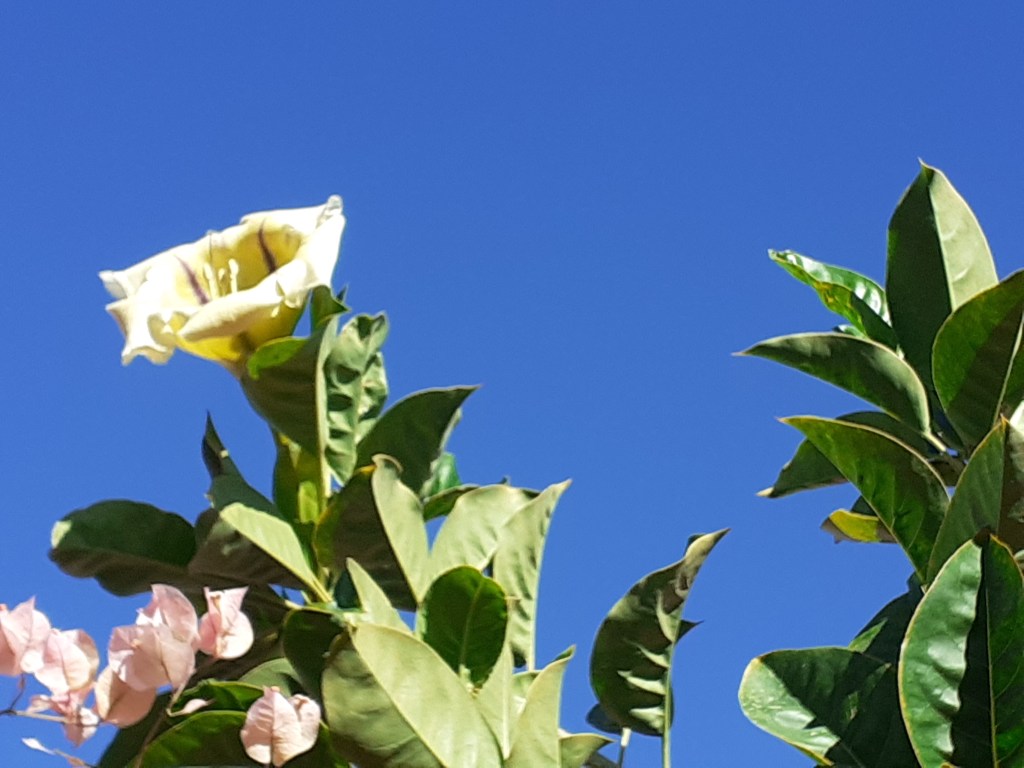
And if you like something a bit spectacular and a little gross, here are the flowers of the cup of gold vine, Solandra maxima. They are about 20cm across! This was growing as a climber at a garden edge with bougainvilleas. Apparently it comes from Mexico and has hallucinogenic properties like some other members of the potato family, the Solanaceae.

 gardentrip.co.uk