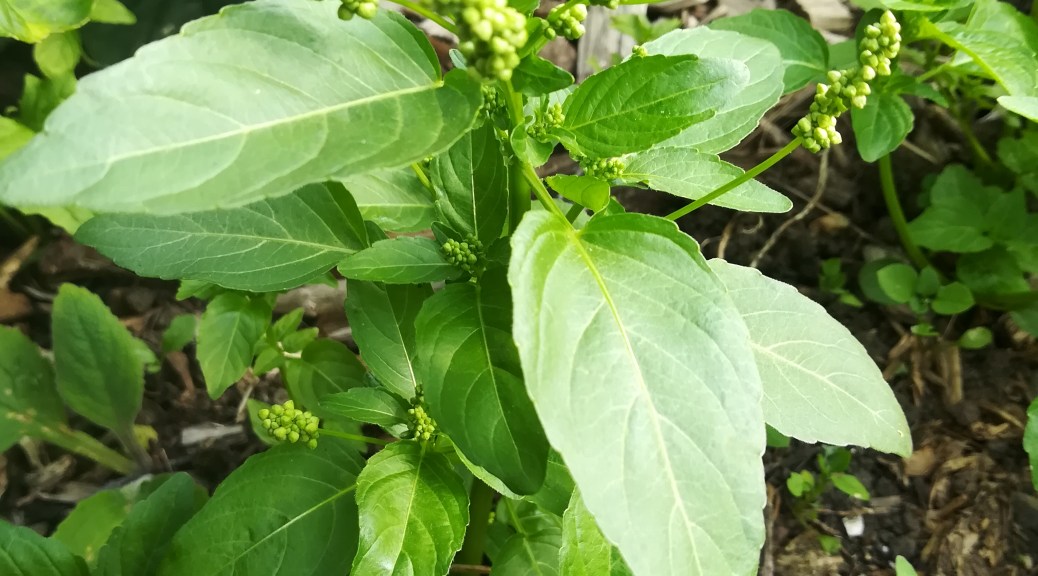
This weed was totally unknown to me before I started gardening in the south of England. Now I wish I could ignore it. It is always the first and most abundant weed to appear on the bare ground in my London allotment. Don’t get me wrong: it is not difficult to remove – you just pull it out. But the problem is that there is just so much of it, and it grows and sets seed very fast!
According to the Online Atlas of the British Flora, Mercurialis annua is ubiquitous but only in the south and east of England. It loves light lowland soils. For those who know about farming, it is mainly distributed below the Tees-Exe line, ie south of an imaginary diagonal line drawn from the mouths of the rivers Tees and Exe. In fact, it’s not so common in Yorkshire either so not surprising I had not seen it during my school years in Teesdale or my student years in Edinburgh.
I became extremely familiar with this weed when I started my London garden. It reminded me immediately of its perennial cousin dog’s mercury (Mercurialis perennis). For me, this is a more noble plant of settled woodlands and hedgerows. I imagine its leaves are a little less thin and translucent, and it can survive in deep shade.

Dog’s mercury is a native plant, the atlas says, being distributed all over mainland Britain up to the Great Glen in Scotland. In the lowlands, it grows in woodlands and hedgerows, and in the uplands it likes basic crags and screes.
Now I hardly ever see the perennial version. It is always annual mercury to excess. When I sow seeds, for example, tiny annual mercury seedlings always appear in abundance. Their first leaves have a characteristic oval shape with noticeable veining. Without intervention these weedlets will swamp any crop.

The Online Atlas of the British Flora suggests the weed is an ancient introduction, via ports and gardens, from more Mediterranean climes. It has been found in Viking deposits in York. Recent mapping over the last 50 years suggests it is still increasing its British distribution.

 gardentrip.co.uk